
After a Missouri Prison Release
MODOC controls Missouri state-prison custody and release, not the Lawrence County Sheriff. A Lawrence County defendant sentenced to MODOC may leave the county jail for reception, diagnostic processing, or a later prison assignment. The Sheriff’s release time records the end of county custody; it does not establish the later state release date.
Missouri uses several distinct milestones. Parole is discretionary release from incarceration. Conditional release is a statutory transition from the prison portion of a sentence to supervision. Probation can be imposed by a court without a prison stay. Final discharge means the MODOC sentence or supervision obligation has ended. Do not collapse a parole hearing date, future release date, CR Date, prison departure, and final discharge into one “release date.”
A person leaving prison may be assigned to a probation-and-parole field office, including District 43 in Aurora when appropriate. That office address is not a prison or the person’s residence. It indicates community supervision. Other holds can still interrupt a planned community release, so a future date should be rechecked after it passes.
Confirm State Release or Discharge
- Open MODOC Offender Search, note the data-current timestamp, and complete the CAPTCHA.
- Use the DOC number if known. Otherwise search first and last name and check aliases. Resolve identity with public biographical, offense, and case context.
- Read the location and status exactly. A correctional institution indicates confinement; a probation/parole field office supports release to community supervision.
- Copy the precise date label. A CR Date is a conditional-release date, not a guarantee or final discharge date.
- Check MOVANS for relevant state events and Case.net for the sentencing judgment, amendments, or revocation history.
- For a missing older offender or a formal discharge answer, ask MODOC for the public release/discharge record using the full name and DOC number.
The active-only design creates a counterintuitive rule: MODOC search can be strongest for someone released from prison but still supervised, yet return nothing after final discharge. No result can also reflect spelling, an excluded or confidential record, county-only custody, or a data issue. State only that the active system returned no record; do not announce discharge from absence alone.
The Lawrence County release search explains the earlier county link. When a Sheriff record and MODOC result both exist, treat them as a chain: county departure, state admission, later state release, and eventual discharge can be four separate events.
MODOC Records and Status Contacts
Missouri Department of Corrections institutions statewide
Offender Search: web.mo.gov/doc/offSearchWeb/
General Board questions: 573-751-8488
Victim Services: 573-526-6516, victims@doc.mo.gov
Specific status: institutional caseworker or assigned field officer
MODOC Constituent Services explains that offender-specific questions belong with the caseworker or field officer, while general search information and policy questions can follow the agency contact route. For full discharge, request the open face sheet, release status and type, release date, applicable conditional-release information, supervision discharge date, and discharge record. Give the full name, DOC number, and appropriate identifying information.
MODOC may withhold health, treatment, victim, presentence, security, and other confidential material. Ask for open portions and the authority for any withholding. The sentencing court’s judgment corroborates the sentence but does not replace the department’s computation or physical-release record.
MODOC State Release System
No adult MODOC prison was identified as physically located in Lawrence County during the official facility sweep. The statewide facility entry represents the institutions that can receive Lawrence County defendants after commitment. It is not a county-jail page, and the Sheriff roster is not the locator for a person after MODOC intake.
MODOC holds sentenced state prisoners and supervises active probationers and parolees. The public search includes active offenders, including those on probation and parole, and expressly excludes discharged offenders. A field-office listing should never be presented as incarceration at that office or as the person’s home address.
The system’s public results and dates can change as data updates, legal decisions, credits, sentence structure, and holds are applied. A public result is useful current evidence, but the caseworker, field officer, records response, and court judgment provide the supporting context.
MODOC Conditional Release Supervision
Missouri’s official explanation describes a prison portion and a conditional-release portion for many sentences. Under § 558.011, qualifying terms of nine years or less generally have a CR portion of one-third; terms over nine through fifteen have three years; and terms over fifteen have five years. Exceptions and extensions apply, so these proportions are not a public calculator.
The official MODOC conditional-release explanation illustrates why release from prison does not necessarily end the sentence:
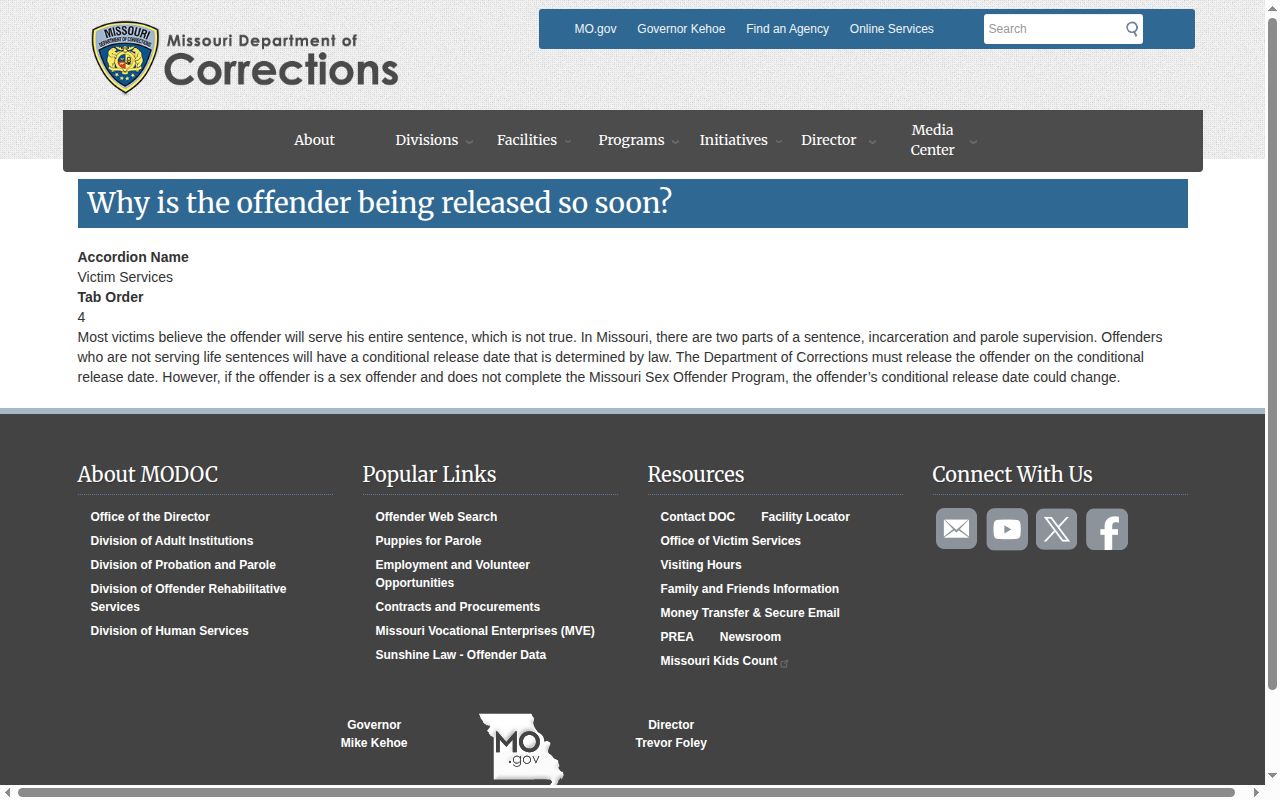
Use the exact displayed label and confirm the individual status. The Board can extend a CR date through the statutory institutional-violation process, and other minimum-term provisions or detainers can control.
Why MODOC Release Dates Change
Section 558.019 includes an 85-percent minimum for a dangerous felony as defined by § 556.061, subject to the age-70 and 40-percent alternative. It is not an 85-percent rule for every Missouri prisoner. Consecutive sentences, offense date, prior commitments, credits, parole exclusions, discipline, and other statutes can alter timing.
A parole eligibility date identifies when Board consideration may occur. A hearing can result in later reconsideration, denial, or a future release date and does not itself prove departure. MODOC says a parole decision normally takes eight to twelve weeks, and hearings occur monthly at institutions under the applicable rule, but Missouri does not publish one name-by-name statewide calendar.
Do not subtract a generic amount from a judgment or promise departure on a future date. Quote the result’s label, check Board information, ask the caseworker about specific status, check for other holds, and verify after the date through MODOC status, MOVANS, or the official record.
Trace MODOC Release Events
MOVANS is Missouri’s notification and search layer for MODOC, local detention, and court events. It can alert a registered user to a reported release or status change, but it is not a certified discharge record. Victim Services can address MODOC notification questions. Corroborate an alert with Offender Search or the department record.
Case.net supplies the durable legal history: judgment, imposed sentence, probation, commitment, amendments, and revocation events. It may not state the physical prison exit time. Read the court and custody sources together, preserving each term. A court sentence and a MODOC calculation answer different questions.
Lawrence County MODOC Release Path
The Lawrence County Detention Center houses people awaiting MODOC transport. Its 48-hour release card can document the time county custody ended but omits destination. If the court shows a state commitment, MODOC may later show reception or an institution after processing. A delay between the two databases does not make either record false.
Ask the Sheriff for the receiving-agency field when the transfer needs confirmation. The Jail Division page documents the awaiting-MODOC population, the 48-hour release view supplies a recent county departure time, and the Lawrence County Circuit Clerk supplies the sentencing-case contact. Once state custody begins, direct release and discharge questions to MODOC. If a later field-office result appears, it supports prison release to supervision, not final completion of the sentence.
MODOC Release Record Boundaries
MODOC records describe custody and supervision, not guilt independently of the judgment. Avoid publishing sensitive individualized conditions or speculating about violations. An active status should be dated and verified because supervision assignments change.
A missing discharged record is a built-in limitation, not permission to rely on stale commercial mirrors. Request the official record and respect sealing, expungement, privacy, and confidentiality rules. For formal proof, distinguish a public web result, notification alert, court copy, and MODOC-certified or official response.
Build a MODOC Release Record
A careful state-release verification preserves several identifiers and dates without blending them. Record the DOC number, the data-current time on the search, the exact active status, the institution or field-office location, and every date with its original label. Add the sentencing case number and judgment, then note the date of any MOVANS event or agency response. This creates an auditable timeline rather than a single unsupported “released” label.
If the timeline begins with Lawrence County, add the Sheriff booking number, county departure time, and receiving agency when available. If it ends with discharge, add the MODOC record that expressly confirms completion. Gaps should remain identified as gaps. Do not fill them with sentence arithmetic, an assumed transport date, or an aggregator’s undated status.
When sources disagree, compare their update times and populations before calling the result an error. A county record, prison result, field-office result, and discharge response can each be accurate for a different stage. Contact the caseworker, field officer, records office, or court clerk responsible for the disputed field and retain the agency’s terminology in the final description.