
After Federal Prison Custody
A BOP release can lead to the community, federal supervised release, another jurisdiction’s custody, or immigration custody. The public locator’s “Released” or “Not in BOP Custody” language means the person is no longer held by BOP. It does not mean every legal obligation has ended. BOP expressly cautions that a person may be held by another authority or remain under supervision.
No BOP institution was identified inside Lawrence County. A Lawrence County resident or defendant in a federal matter can be designated to a BOP facility elsewhere. Location does not change the correct search: BOP controls post-sentencing federal prison records nationwide.
A local arrest can also involve a federal warrant without creating an immediate BOP result. The U.S. Marshals Service handles many federal pretrial detainees and can use contract facilities. BOP generally becomes the appropriate public locator after sentencing and designation.
Confirm a BOP Release
- Open the BOP Inmate Locator.
- Use a BOP register, DCDC, FBI, or INS number when known. Otherwise search by name and narrow with age, race, and sex fields.
- Compare the register number and biographical details. Do not match identity by name alone.
- Record the location/status and release date exactly as displayed. Distinguish a future date from a completed release.
- If the result says Released or Not in BOP Custody with no facility, report only that BOP custody ended. Check the federal court and any implicated state, local, or ICE system separately.
- Use BOP FOIA for older or more detailed records and provide adequate identifiers and any required authorization.
The BOP locator warns that dates may change during First Step Act recalculation. A future date is planning information, not a promise of physical release. Recheck the result after the date and investigate detainers or other custody when appropriate.
The Lawrence County release guide should be used only for the local part of a custody chain. A Sheriff record can show departure from the county jail, while BOP can later show federal custody or release. The two records document different agencies and times.
BOP Locator and Records Contact
Federal Bureau of Prisons system
Nationwide federal prison system
Public status: BOP Inmate Locator
Detailed records: BOP Freedom of Information Act route
No BOP institution was identified in Lawrence County.
The locator is the primary public release-status channel for sentenced federal prisoners from 1982 onward. Results commonly include name, register number, age, race, sex, release date, and location or status. Preserve the federal terms and date checked.
For a formal or more detailed record, use the BOP FOIA process. A request needs enough identifying information to locate the record. Privacy-sensitive information may require identity verification, consent, or authorization, and exemptions can apply. A public screenshot should not be called a certified release record.
For a federal pretrial person who does not appear in BOP, use the federal court or U.S. Marshals route. Do not redirect an ordinary federal sentence to the Lawrence County Sheriff merely because the person has county ties.
A Nationwide Federal System
BOP operates federal prisons for people serving federal sentences. It is not the Lawrence County Detention Center, Missouri Department of Corrections, U.S. Marshals Service, or ICE. Each agency has a distinct population and locator.
The public locator’s 1982-forward scope makes it useful for many historical federal releases, but it is not an all-purpose federal arrest database. Pretrial USMS custody, immigration detention, military custody, and state or local detention require their own sources.
No local BOP address, capacity, release desk, visiting room, or transport service should be invented for Lawrence County. Facility-specific operations depend on the actual BOP institution shown in the result. Contact that institution through BOP’s official directory when current operational information is needed.
Read the Federal Locator Result
The official BOP locator provides the federal search interface:
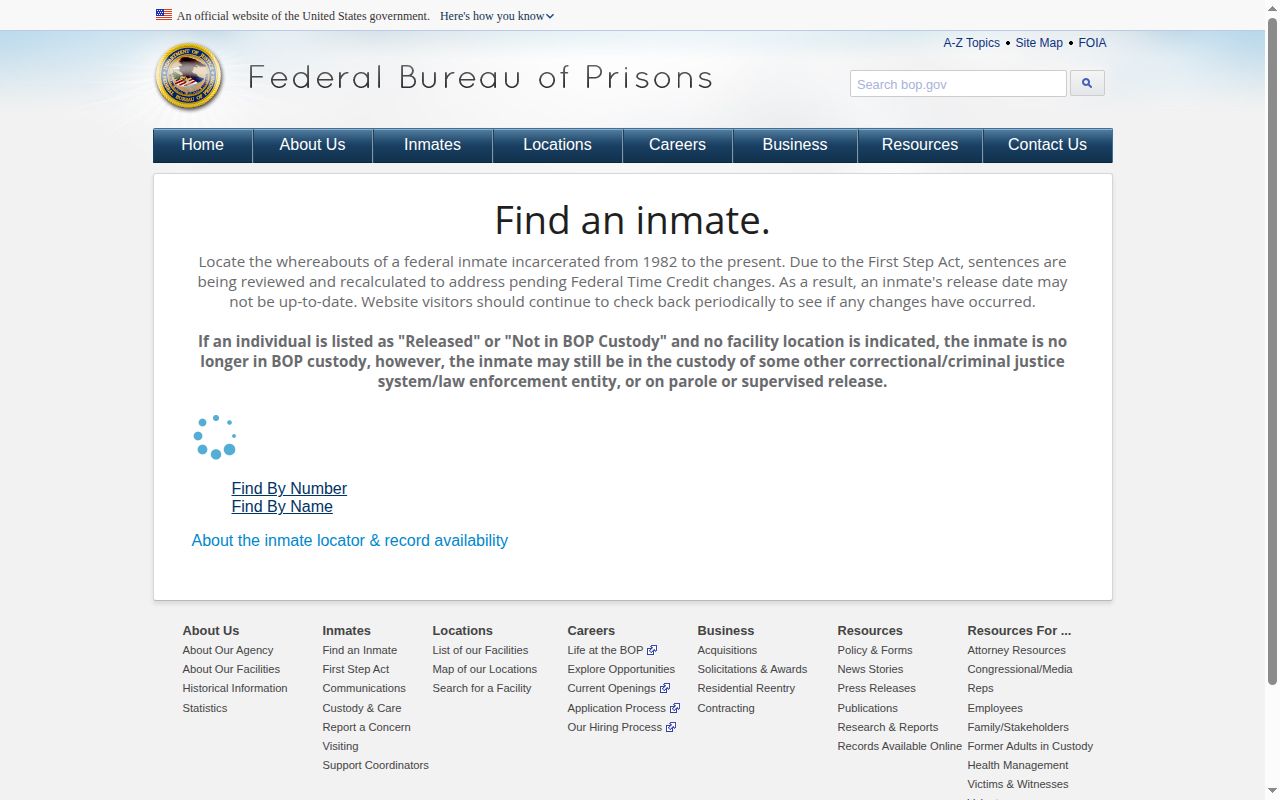
Use the number search whenever possible and treat the displayed status as limited to BOP custody. The image shows the search channel, not proof about any particular person.
Released from BOP Is Not Unconditional Freedom
Federal supervised release is imposed and administered through the federal court and probation system, not shown as incarceration at a BOP institution. A person can be out of BOP custody and still subject to court-ordered supervision. Another warrant or sentence can also result in transfer to a different custodian.
If ICE ODLS shows current custody after BOP displays release, the records are consistent: federal prison custody ended and immigration custody began. Describe the transfer between systems rather than claiming community release.
Federal Pretrial Custody Uses USMS
The U.S. Marshals Service manages many federal pretrial prisoners and may house them under agreements in non-BOP facilities. A person arrested on a federal charge may therefore be absent from the BOP locator before sentencing or designation. Check the federal docket and contact the responsible USMS district for that stage.
No evidence in the research identifies the Lawrence County Detention Center as a dedicated USMS facility. Do not infer a federal contract from a local arrest or from the possibility of federal detainers.
Link a Lawrence County Event Carefully
The Sheriff’s 48-hour release roster can show when a person left the Lawrence County Detention Center, but it omits destination. If a federal pickup is suspected, request the receiving-agency entry. The BOP locator may not update until later processing and designation.
The Sheriff’s 48-hour view, Lawrence County records contact, and Circuit Clerk contact can document the local part of a chain. A Case.net record covers Missouri cases, while a federal criminal docket belongs in the federal court system. Do not use a state docket to explain a federal sentence. Preserve separate case numbers and agencies across the chain.
Future Federal Dates Can Move
BOP says release dates may be affected by recalculation, including First Step Act work. A future locator date should be quoted with its label and checked again. Detainers and other sentences can prevent a person from entering the community even when BOP custody ends.
A past displayed release date supports departure from BOP, subject to the result’s current wording. For formal proof or underlying documents, request the federal record rather than relying on an undated commercial profile.
Federal Record Guardrails
A federal conviction record, custody result, or release date should be reported in context and with its source date. Avoid publishing unsupported offense claims or speculating about supervision. A public prison record is not permission to disclose protected personal information.
Verify with BOP, the federal court, USMS, or the next custodian as appropriate. Respect sealing and privacy restrictions. The agency that created each record is the authority for its meaning and current status.
Build the Federal Custody Timeline
Start with the federal court case and identify whether the person is pretrial, sentenced, or serving a term of supervised release. A pretrial defendant may remain under USMS authority even when housed in a local or contract facility. A sentenced defendant can enter BOP after designation. These stages determine which office can answer a release question.
For BOP custody, preserve the register number, facility or status, displayed release date, and lookup date. A future date should remain described as future and subject to recalculation. After a completed release, check the federal court record for supervised release and ask whether another custodian received the person when the facts indicate a hold or transfer.
If a Lawrence County event began the chain, add the Sheriff booking number, departure time, and receiving authority without combining the local and federal events. If ICE later appears, record that as another distinct transfer. This timeline prevents “not in BOP custody” from being expanded into “not in any custody.”
Older and Detailed Federal Records
The locator’s 1982-forward coverage leaves older federal prison history and detailed institutional documents outside the ordinary search. BOP FOIA is the appropriate route for agency records, subject to identification, privacy, and exemption requirements. State exactly which record or date is sought and include the register number when available.
Federal court records may document the sentence, later modifications, revocation, and supervised-release proceedings but not every physical transfer. USMS records address the pretrial custody layer. Requesting each record from its creator is more reliable than an all-purpose commercial profile, particularly when similar names or old dates create identity risk.